
Gilchrist County Court Records After a Jail Arrest
Once a person is arrested and booked into the Gilchrist County Jail, the case does not stay with the sheriff. The Sheriff's Office runs the jail and records the booking. The prosecutor, called the State Attorney in Florida and not a District Attorney, then decides what charges to file. When that filing happens, a case opens with the court. That filed case is the court record. So an arrest starts the clock, but the court record is shaped by what the prosecutor files, which can match, change, or differ from the charges written at booking.
The arrest and booking side and the court side are kept apart on purpose. Booking detail, custody status, and the bond shown at intake live on the roster, covered on the jail inmate records page, and the booking photo appears on the jail mugshots page. The court record is the formal charge file the prosecutor filed and the clerk maintains. To track court records after an arrest, you work the clerk's case index, not the jail roster. The roster tells you someone is in custody. The court file tells you what they are formally accused of and how the case is moving.
The State Attorney for the Eighth Judicial Circuit prosecutes Gilchrist County cases. That circuit covers six counties, and one office handles charging decisions across all of them. The Gilchrist County Clerk of the Circuit Court and Comptroller is the office that holds the filed case once charges are in.
How to Find Gilchrist County Court Records After an Arrest
Court records after an arrest live with the Gilchrist County Clerk of the Circuit Court and Comptroller. The clerk's main site links the case index, and the actual search runs through the state Civitek system. The clerk's menu labels the link "Search Court Records." Before you start, check the jail roster for a court case number tied to the booking, because that number is the fastest way into the right court file. The roster carries the arrest and booking detail. The clerk's index carries the charges the prosecutor filed and the status of each one.
The clerk's homepage is a good starting point because it also carries redaction notices and contact details. You can reach the clerk's online services through the Gilchrist County Clerk of Courts website.
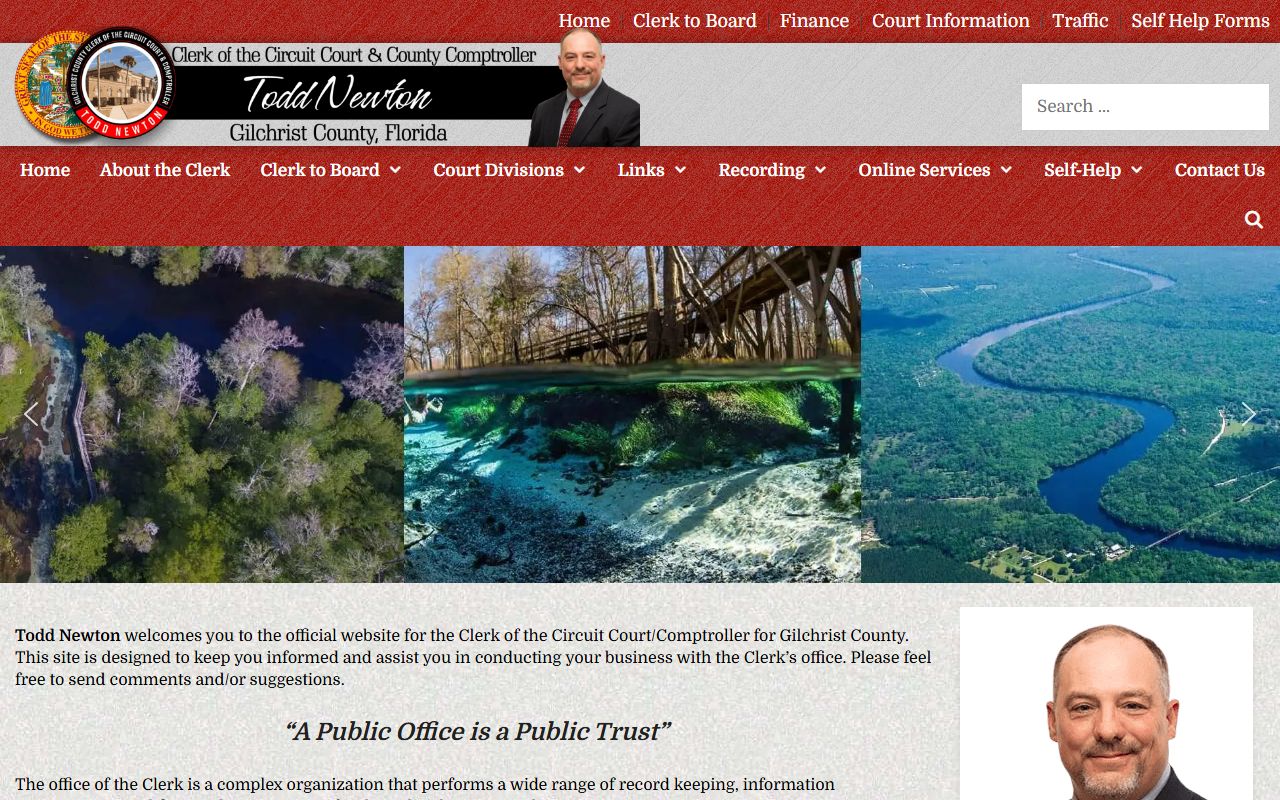
From that homepage you reach the same online court records search used to confirm charges and charge status after a Gilchrist County arrest.
- Open the Gilchrist online court records search at the Civitek portal and choose an access option. Most members of the public use the Public choice, which the portal describes as anonymous access.
- Search by court case number if the jail roster showed one, or search by defendant name in the public option. Try first, middle, and last name variations if a name search returns nothing.
- Open the case and read the full charge list. Match it against the booking charges, since the filed charges can differ from the arrest charges.
- Check each charge for its statute code, degree, level, and current status, and note whether the case sits in county court or circuit court.
The public access screen for the county is the place where most readers start a name or case-number search. You can open it directly through the Gilchrist County online court records search.
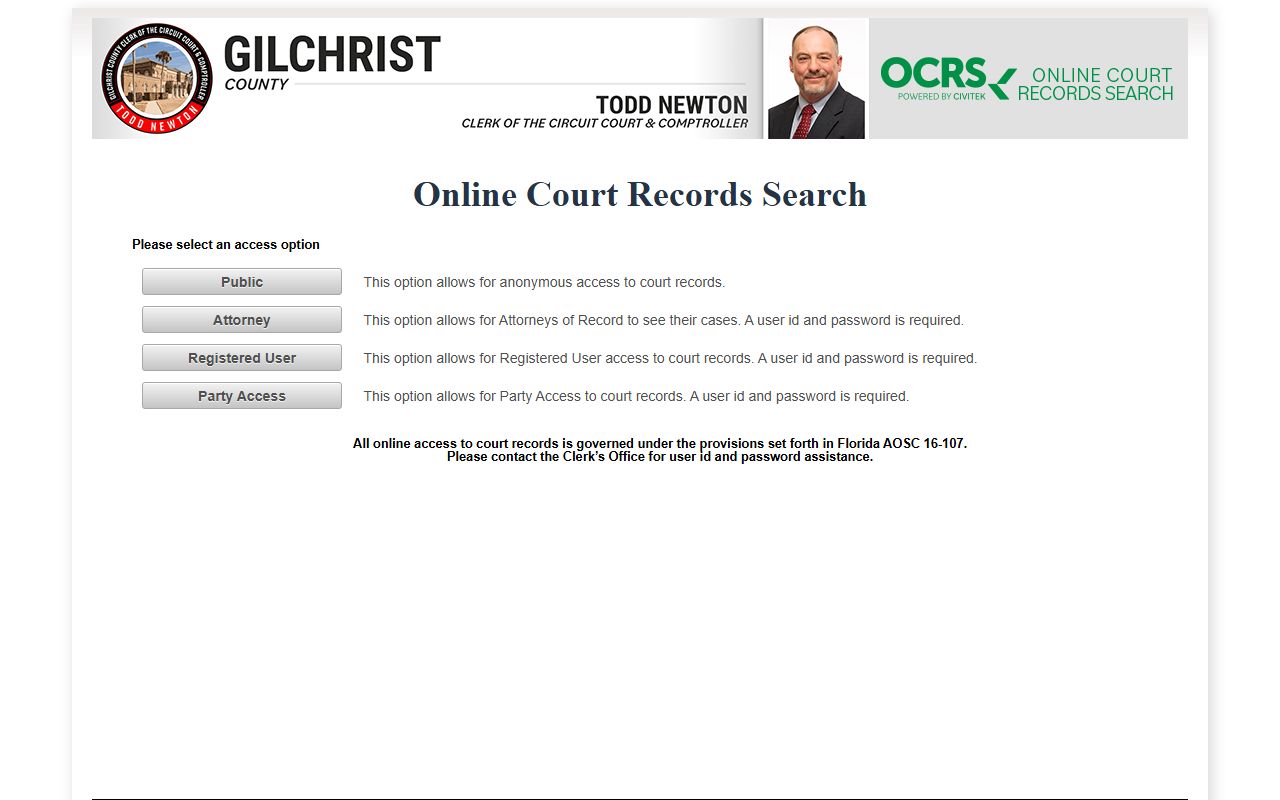
That access screen splits users into Public, Attorney, Registered User, and Party Access, and only the Public path runs without a login.
Watch how the case is filed. Misdemeanor cases are usually county court, and felony cases are usually circuit court, so check both criminal categories if the search splits them. For a statewide picture beyond one county case, the Florida Department of Law Enforcement runs a criminal history record check. You can read the rules at the FDLE criminal history information page. That route is a statewide criminal history channel, separate from a single local court file.
How Charges Get Filed After an Arrest: Complaint, Information, and Indictment
Walk the timeline forward. An arrest leads to booking at the jail, and booking creates the arrest charges in the jail system. The court record starts when a prosecutor formally files a charging document. In Florida the State Attorney usually files an "information" for many felonies, while serious felonies can go to a grand jury that returns an indictment. A complaint or sworn affidavit from an officer can start the lowest-level cases. Each path opens a court file, but the document type tells you who decided to bring the charge.
| Complaint | Information | Indictment | |
|---|---|---|---|
| Filed By | Officer / Prosecutor | State Attorney | Grand Jury |
| Common For | Misdemeanors | Many felonies | Serious felonies |
| Starts | The case | The case | The case |
The booking charge and the filed charge are not always the same. A person can be booked on one set of charges and then face a different set once the State Attorney reviews the case and files. The filed document, not the arrest paperwork, controls what the case becomes.
The State Attorney for the Eighth Judicial Circuit makes that filing decision. You can review the office through the Eighth Judicial Circuit State Attorney page.
That office files the charges that turn a Gilchrist County arrest into a court case, while the filed record itself stays with the clerk.
Charge Status in Gilchrist County Court Records
Charges change as a case moves. A charge can be amended, reduced, added, dropped, or dismissed. The booking charges on the jail roster can differ from the charges the prosecutor finally files, so always read the court file for the current status rather than relying on the arrest charge alone. The terms below show up in case dockets and tell you where each charge stands.
| Status | What It Means |
|---|---|
| Pending | The case or charge is open and still moving through the court. |
| Filed | The prosecutor has filed a formal charge or information. |
| Amended / Reduced | The charge was changed after filing, or lowered to a lesser offense. |
| Dismissed | The charge was ended by a court or prosecutor action. |
| Nolle Prosequi | The prosecutor declined to proceed and filed no information. |
| Disposition | The final outcome of the charge or the case. |
Note: A disposition is the end result, while a conviction or adjudication is a court outcome that is not the same thing as the original arrest or booking.
Bond and Release After a Gilchrist County Arrest
Bond is the money or set of conditions that lets a person leave jail while a case is pending. After an arrest, the jail records a bond amount and a per-charge bond, and a judge sets or reviews release conditions at a first appearance. The roster shows the bond amount near the top of each record, but the dollar figure alone does not tell the whole release story. Some records show $0.00, and that can mean no bond is allowed rather than a free release.
| Bond Type | How It Works |
|---|---|
| Cash Bond | Money posted directly through the responsible court or jail process. |
| Surety Bond | A licensed Florida bail bond agent posts the bond for a fee. |
| PR / Own Recognizance | Release on a written promise to appear, without a full cash payment. |
| No-Bond Hold | The person stays in custody and cannot be released on a normal bond. |
Holds and detainers complicate release. A hold from another county, the Florida Department of Corrections, or immigration authorities can keep a person in custody even after a local bond is posted. Because the official jail pages do not publish a bond desk schedule or accepted payment methods, call the Gilchrist County Jail at (352) 463-3490 before you try to pay anything. Ask the jail whether posting the local bond will actually cause release, since a separate hold can block it.
Warrants That Lead to a Gilchrist County Arrest
An outstanding warrant can produce the arrest that starts a court record. When a person is arrested on a warrant in Gilchrist County, the booking flows into the sheriff's SmartWEB jail system, and the charge table can carry warrant detail such as a failure to appear entry with a felony warrant note. A court case number in a warrant row points you to the clerk's case file. There is no official local active-warrant portal published by the Sheriff's Office, so use a few channels together rather than one search.
- Search the SmartWEB jail roster for a person recently arrested on a warrant.
- Search the clerk's case index for bench warrants, failure-to-appear events, and docket entries.
- Check the FDLE wanted, missing persons, and stolen property database at the statewide FDLE search.
- Call the Sheriff's Office at (352) 440-7361 for agency routing, or the jail at (352) 463-3490 if the person may already be in custody.
Note: A bench warrant is often issued by a judge for missing a court date or violating a court order, and a $0.00 or no-bond warrant row can still mean a person waits in custody for a hearing.
Charges vs. Convictions in Court Records
Being arrested and charged is not the same as being convicted. A charge is an accusation that opens the case. A conviction is the court outcome after a plea or a verdict. Both can appear in public court records, but they sit at very different stages, and confusing the two leads to real mistakes when reading a file after an arrest.
| Charge | Conviction | |
|---|---|---|
| Stage | Accusation | Verdict or plea |
| Burden of Proof | Probable cause | Beyond reasonable doubt |
| Public Record | Yes | Yes |
A charge can end without any conviction at all. It can be dismissed, reduced, or dropped through a nolle prosequi. Reading the disposition is the only reliable way to learn whether a charge after an arrest turned into a conviction.
Sealed vs. Expunged Records After an Arrest
After a dismissal or an eligible disposition, a person may be able to seal or expunge a record tied to an arrest. Sealing restricts public access to a record without destroying it. Expunction goes further. Florida's court-ordered expunction process is set out in statute, and you can read it at Florida Statutes section 943.0585. This is a court and FDLE process, not a filter the jail roster applies on its own.
| Sealed | Expunged | |
|---|---|---|
| Visibility | Hidden from public | Destroyed or treated as never existed |
| Law Enforcement | Limited access | Very limited |
| Eligibility | Set by Florida statute and a court order | Court-ordered under section 943.0585 |
Because expunction runs through the court and FDLE, a sealed or expunged result is not something you arrange by contacting the jail. The person seeks the court order first, then works with the originating agency to apply it. The roster and the court index reflect the change only after the order is in place.
Background Checks and Court Records
A casual lookup of a court record after an arrest is not the same as a regulated background check. A background check used for employment, housing, or credit must follow the federal Fair Credit Reporting Act, which sets accuracy and notice rules that a quick public search does not. Court records and the jail roster show what is filed and public, but they are not a screening report, and they can be incomplete or out of date.
Important: This site is not a consumer reporting agency under the FCRA, and nothing here may be used to decide credit, employment, housing, insurance, or tenant matters.
Restricted Court Records After an Arrest in Gilchrist County
Not every record tied to an arrest is open to the public. Florida law sets exemptions that can keep a record out of a public search. Juvenile records, sealed charges, and active criminal investigative information can be withheld under Florida Statutes section 119.071. You can read those exemptions at the section 119.071 exemptions page. Sensitive images and certain law-enforcement records also fall under these rules.
An empty result does not prove a case never existed. A record might be sealed, restricted while an investigation is active, or filed under a name spelling you have not tried. When a public search returns nothing and you still need an answer, call the Gilchrist County Clerk at (352) 463-3170 or request records through the clerk's office. For prosecutor-side filing questions, the Office of the State Attorney for the Eighth Judicial Circuit handles charging across the six-county circuit, while the filed case record itself stays with the clerk.